

Competencies
At this point, I could list all the skills I possess. Instead, you get a deeper insight: my meta‑competencies.
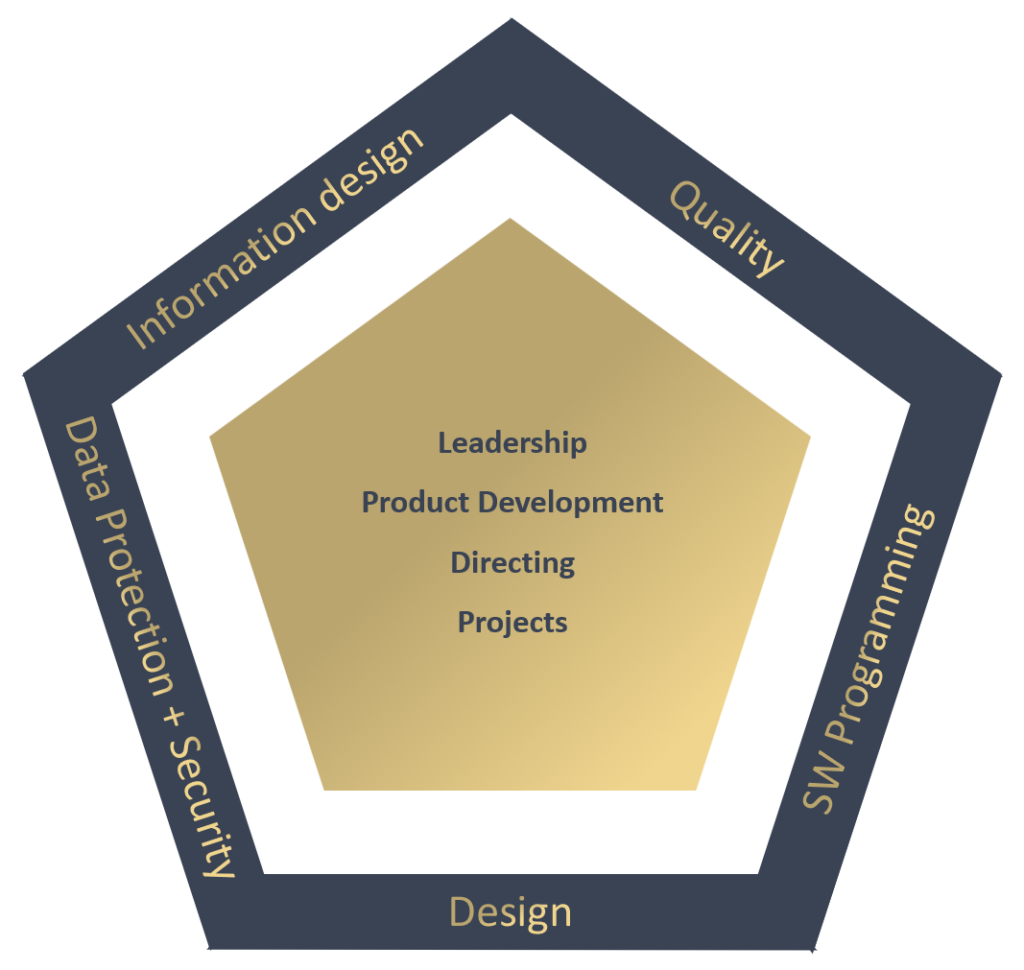
“Meta-Competencies”
Meta‑competencies are overarching cognitive and practical abilities that make it possible to connect, analyze, and shape different fields of expertise at a high level.
They are the reason why I can truly be deployed independently of any specific domain in Governance & Transformation.
1. Systems Thinking & Structuring Skills
All these areas – data protection, IT, software, quality, information design, and design – require me to grasp complex subject matter, organize and abstract it, and translate it into functional structures.
This forms the basis for:
- Information Architecture
- Quality Models
- Software Concepts
- Data Protection Processes
- Design Systems
2. Precise analytical skills and problem-solving competence
- Pattern Recognition
- Root Cause Analysis
- Risk Assessment
- Derivation of measures
Whether a UI is being optimized, a security concept reviewed, or a report generated – the process is always analytical.
3. Ability to Abstract & Model Building
- Data Models
- Process Models
- Quality Models
- Security Models
- Design- and Interaction Models
That means: Chaos becomes order by abstracting, prioritizing and generalizing.
4. Communication and translation skills
All my fields are interdisciplinary.
Technology ↔ Management
Law ↔ Practical Experience
Design ↔ Business
User Needs ↔ Systemic Logic
5. High level of sensitivity to users, risks, and impacts
- Usability
- Psychology
- Security
- GDPR
- Esthetics
- Empowerment Tools
How does it affect the user?
How secure is it?
How understandable is it?
How sustainable is it?
6. Commitment to Quality &
Attention to Detail
All fields are required:
- Thoroughness
- Consistency
- Error Prevention
- Documentation
- Traceability
7. Creativity + Structure
- Creativity (Design, Creation,
Empowerment Tools) - Structure (GDPR, Security, Quality
Management)
This combination is unusual and makes my profile special.
8. Interdisciplinary mindset & ability to learn
- understand new technologies
- assess new legal requirements
- identify new security risks
- evaluate new design trends
Continuous learning – or “updating” – is essential.